Episode 273: Open Center Conditioning with Maggie Hilpisch

Returning to the show is Maggie Hilpisch. Maggie first joined me in Episode 267 on Parenting Through Human Design. While recording that episode, we realized that we’re Splenic Projectors with two defined centers and one channel.
So, I invited Maggie back for a candid conversation on the similarities and differences between our designs.
You’ll hear us reflect and share insights on:
Having Splenic Authorities
Our 1 / 3 and 2 / 4 Profile Lines
Working with seemingly contrasting parts of one’s design
Self-doubt and overthinking
Open Centers and conditioning
Listen to the Episode:
Mentioned in the Episode:
Connect with Maggie Hilpisch:
Connect on Instagram
Share the Episode:
“Are we directing our energy in the direction that we’re following? Are we following our intuition? Are we in a community that makes us feel recognized - and not conditionally recognized, or a fleeting recognition - but truly recognized so we can have an impact? It’s been a lesson for me -identifying the spaces and places where I do feel recognized and feel a sense of belonging in a way that’s really healthy.”
Read the Transcript:
Coming Soon!
You know how the saying goes, “trust your intuition”? It sounds great — until you're staring at your meal plan, second-guessing your symptoms, and wondering why you still don’t feel like yourself.
This episode is about self-leadership — and how Human Design gives you a practical path back to trusting your judgment, body, and energy again.
We’ll unpack what self-leadership really means, the subtle ways we learn to override it (even with “good” advice), and how each of the seven Human Design Authorities offers a tangible, practical approach to building that trust again — one decision at a time.
This isn’t about ignoring input or never asking for support. It’s about becoming the kind of person who knows how to hear themselves — and lead themselves — even in the noise.
In this episode:
What self-leadership is (and isn’t)
Why wellness culture often disconnects us from our inner compass
Seven ways Human Design helps you stop outsourcing your decisions
The difference between following intuition vs. understanding your Authority
Are tracking apps harmful?
For the longest time, I didn’t know how to listen to my body.
In this episode, I discuss how tracking apps gave me data - completely personalized insights that helped me understand my body in real time every day.
I share how they taught me how to quantify my body functions in ways that aren’t obvious, ultimately helping me gain self-awareness and body awareness—not how some magazine, social media influencer, book, or TV show tells me how I “should” feel.

When speaking of their Human Design, I often hear language classifying things as “good” or “bad,” but there isn’t anything “good” or “bad” in one’s Human Design.
So, in the episode, I clarify the following misconceptions about Human Design:
Defined Centers are “good”
Undefined Centers are “bad”
Influence is “bad”
My Human Design doesn’t resonate with me, so it’s “wrong”
I’ve been conditioned, so I did something “wrong”
There’s always a “like for like” answer
…and how to reframe your perception of them.

Returning to the show is Maggie Hilpisch. Maggie first joined me in Episode 267 on Parenting Through Human Design. While recording that episode, we realized we’re Splenic Projectors with two defined centers and one channel.
So, I invited Maggie back for a candid conversation on the similarities and differences between our designs.
You’ll hear us reflect and share insights on:
Having Splenic Authorities
Our 1 / 3 and 2 / 4 Profile Lines
Working with seemingly contrasting parts of one’s design
Self-doubt and overthinking
Open Centers and conditioning

One of the most incredible things about Human Design is not only is it a framework to gain insight into ourselves so that we can step into our personal power, but it's also amazing because it provides insight into how we can better our relationships with others.
In Episode 241, I highlighted the insights that Human Design Definitions can provide on relationships, and in Episode 242, I answered listener questions on how to navigate Projector + Projector relationships.
In this episode, I answer more listener questions on how Projector + Generator / Manifesting Generators can mutually support each other and optimize their relationship.

One of the most incredible things about Human Design is not only is it a framework to gain insight into ourselves so that we can step into our personal power, but it's also amazing because it provides insight into how we can better our relationships with others.
Since Episode 241 highlighted the insights that Human Design Definitions can provide on relationships, I’m answering listener questions on how two Projectors can navigate relationships in this episode.

Definition? Split Definition? Triple Split? Definition? Quad Split Definition? What do these terms mean?
In this episode, we examine:
What are Definitions in Human Design
The different Definitions and what they mean
Why does Definition matter, and what insight it provides on relationships

A frequent question is, “Now that I know my Human Design, what do I do with it?”
So after releasing an episode on a Human Design fundamental, I like to follow it up with reflections on it from my own Human Design to demonstrate what I do with it.
The last episode, Episode 239, was on the Incarnation Cross in Human Design (hint: it’s our life theme, spanning all aspects of our lives throughout the span of our lifetimes).
In this episode, I share my Incarnation Cross, going over each of its four gates and then what their combination means.
I also share my thoughts on:
My reaction to learning about my Incarnation Cross and how it landed with me
How my perspectives of it have evolved
The impact it’s had on how I live since learning about it

The Human Design Incarnation Cross. It’s one of the things most people are curious about, no matter how much they know (or don’t know) about Human Design.
In this episode, I discuss:
What the Human Design Incarnation Cross is
Why are people so fascinated with it
How to find your Incarnation Cross (and what to do with it!)

In this episode, I’m joined by Anna Lois Davies, a Manifestor with an Ego Authority.
Anna is a Human Design & Business Alignment coach & consultant who is breaking down the boundaries of the binary way of business. She blends Human Design with brand & business strategy so conscious founders & entrepreneurs can find alignment, connection, and abundance in the way that they are uniquely designed to do so.
You’ll hear Anna share:
How she came to Human Design and how it’s influenced her life personally and professionally
What’s an Ego Authority
What’s her decision-making process as she follows her Ego Authority

In my observations (and from first-hand experience), Projectors, more than any of the other Human Design Types struggle with their Strategy of “Waiting for the Invitation.”
In this episode, I share:
A recap of what “Waiting for the Invitation” means
What are invitations and how to recognize them
If invitations can be created
Observations from my experiments with invitations and what made it all “click” for me

In this episode, I answer a listener's question on when to follow your Human Design Strategy versus when not to.
You’ll hear me share:
What does Strategy mean in Human Design
What are the Strategies for each Human Design Type
When to follow it (examples included!)
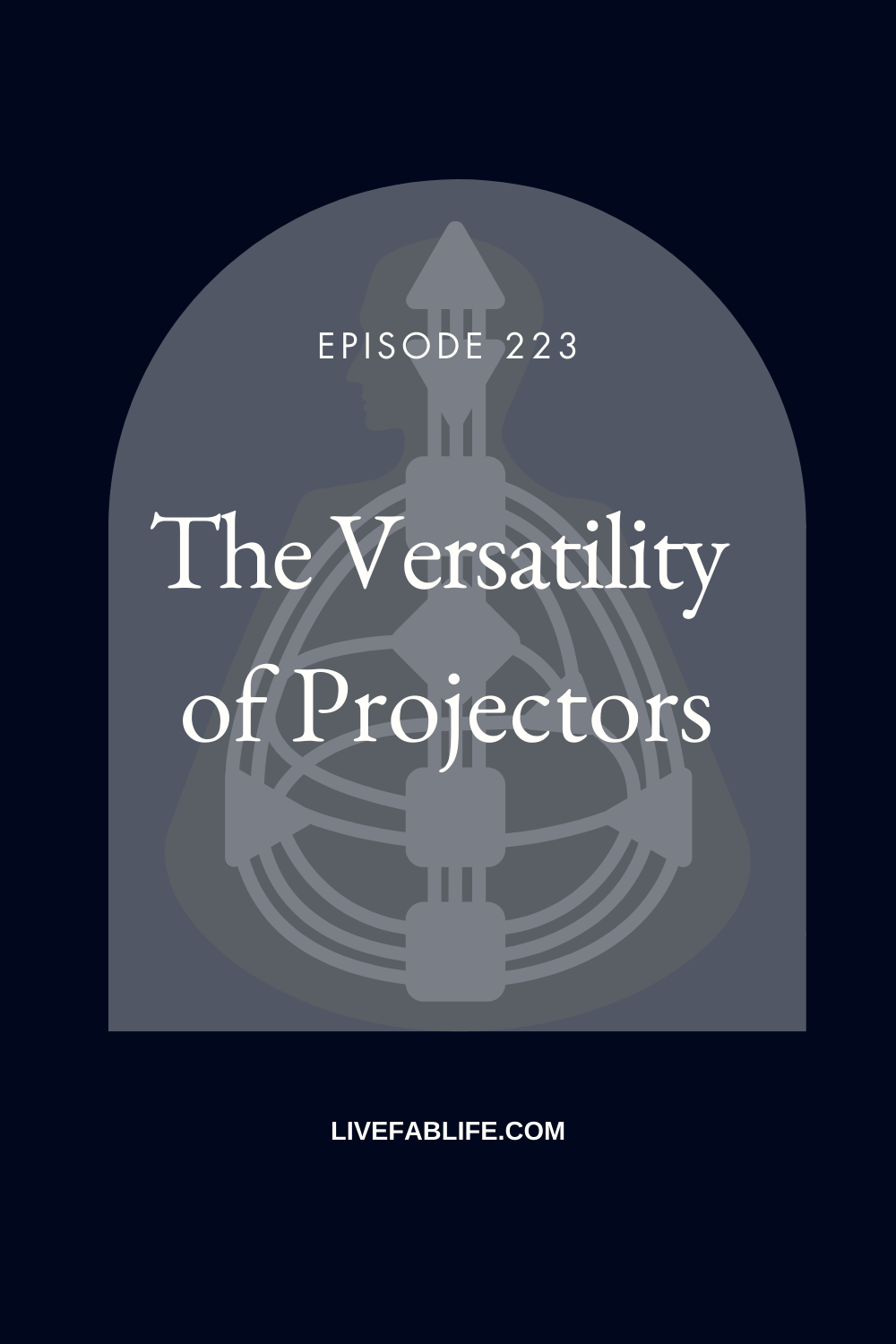
By nature, Projectors are intuitive, resourceful, and also, multi-faceted - there are many layers to us. We’re complex people, and with that complexity comes versatility.
In fact, did you know that Projectors are the most versatile of all the Human Design Types?
Expanding on Episode 222 on what’s great about Projectors, in this episode we discuss:
The three different categories of Projectors
The five different kinds of Projectors
A breakdown of the Human Design body graph chart that determines each kind of Projector

There were so many questions submitted for Episode 217: Projectors Rapid Fire Q&A that we simply couldn’t answer them all.
So in this episode, I’m answering one of the unanswered questions: “How can I like being a Projector when it sucks to have a penetrating aura?”
You’ll hear me share:
A recap of what the Projector Aura is
The challenges that aura can present (why it might feel like “it sucks”)
Tips to work through those challenges
The episode is the first of many more episodes answering those unanswered Projector questions.

If you’re a Projector, or you have a Projector in your life, this episode is for you!
Returning to the show is Nadia Gabrielle. Nadia helps her clients set themselves up for success in their lives and businesses through Brand Building, Design Thinking, and Service Design, incorporating Human Design into her work.
She’s joined me in Episode 179: Subconscious Capacity Building and Episode 201: Exploring A Self-Projected Authority.
Nadia also runs @ProjectorsInvited, an Instagram account for Projectors with a sense of humor.
In this episode, Nadia and I do a rapid-fire session, answering Projector questions submitted by her followers on invitations (Projectors’ strategy), relationships, careers, and the awesomeness of being a Projector.

What do the numbers on the Human Design chart mean? This is one of the most commonly asked questions I’m asked, and one of the first questions I had myself when I was first introduced to Human Design.
Short answer? They’re called gates.
Long answer? That’s what we explore in this episode.
We’ll chat about:
What are gates
What are channels
Two gates from my Human Design

How are you motivated? What compels you to act - to take action?
Continuing our exploration of the Human Design Variables, in this episode, we take a look at Human Design Motivations.
You’ll hear:
What’s Motivation in Human Design
Where Motivation fits into the Human Design variables framework and how it corresponds to the other Variables
The six kinds of Motivations, their Transverse Motivations, and their Trajectories
And we take a brief look at the View Variable

What role do your surroundings play in your life?
Continuing our exploration of the Human Design Variables, in this episode, we take a look at Human Design Environments.
You’ll hear:
What are Environments in Human Design
Where Environment fit into the Human Design variables framework and how it corresponds to the other Variables
The six kinds of Environments, their tones, and what they represent

Do you have a trait or “sense” that you excel at? It’s a knack that you have that not very many others possess.
Continuing our exploration of the Human Design Variables, in this episode, we take a look at Cognition.
You’ll hear:
What is Cognition in Human Design
Where Cognition fits into the Human Design variables framework and how corresponds to the other Variables
The six kinds of Cognition and how they show up

In the last episode, Episode 197, I introduced the Human Design Variables. In this episode, the second installment in this mini-series we take a look at the variable of Determination.
You’ll hear:
What is Determination in Human Design
How it fits into the framework and corresponds to the other Variables
The six kinds of Determination and the tones for each one

Did you know that there’s an element in Human Design connected to digestion?
As a Functional Nutrition Health Coach that specializes in digestive and gut health, when I heard this, I was so intrigued that I just had to learn more.
Just as Functional Nutrition recalibrated my thinking to going beyond the surface to look at what’s at the root of everything, I quickly realized that this is what Human Design has come to do for me as well. It’s a deeper way to look after my well-being beyond what’s just on my plate.
And the Human Design Variables is yet another layer of how Human Design sheds light on our health in literal and energetic ways.
In this episode, I provide an overview of what the Human Design Variables are, and it kicks off a mini-series where we’ll explore each variable and how they complement each other.

Human Design encourages us to explore our true selves versus our conditioned selves and embrace our natural gifts. Your Human Design Type is how our energy functions in the world, our Authority is how we’re meant to make decisions, and our Profile Lines are our personalities. It adds another “flavor” that, in combination with other parts of our design, makes us unique!
In this episode, we explore the six Profile lines and I share how learning about my Profile Lines 1 and 3 resonated with me.

What does manifestation mean to you?
Concluding with the 4-part mini-series on exploring the nine energy centers in the Human Design chart, in this episode, we explore the final two energy centers, the centers of manifestation - the Throat and G-Centers.
You’ll hear me share:
What the Throat and G-Centers represent and governs
What it means for each center to be defined or undefined
How each manifestation center brings about our truth

Awareness is essential to conscious living and self-development. So, how aware are you?
Continuing with the 4-part mini-series on exploring the nine energy centers in the Human Design chart, in this episode, we explore the three awareness centers: the Ajna, Spleen, and Solar Plexus centers.
You’ll hear me share:
What the Ajna, Spleen, and Solar Plexus centers represents and governs
What it means for each center to be defined or undefined
How each awareness center brings mind-intelligence, body-intelligence, and emotional intelligence

Are you calm under pressure? Or are you one who wants to do anything you can to relieve pressure as quickly as possible?
Continuing with the 4-part mini-series on exploring the nine energy centers in the Human Design chart, in this episode, we explore the two pressure centers: the Head and Root centers. You’ll hear me share:
What the Head and Root centers represents and governs
What it means for each center to be defined or undefined
How it can impacts our resilience and ability to respond to stressful situations

In Human Design, your Type, Strategy, and Authority are the foundation of your design. But those things are determined by the nine energy centers in your chart and whether they’re defined or undefined.
This episode begins a 4-part mini-series on exploring the nine energy centers in the Human Design chart.
In this episode, we explore the four motor centers: Root, Solar Plexus, Sacral, and Heart centers. You’ll hear me share:
What each center literally and figuratively represents
What each center governs
What it means for each center to be defined or undefined

How do you make decisions? Do you make a pro vs con list? Do you “go with your gut?” Do you overthink? What’s your decision-making process and how is it working for you?
In Human Design, each person has an “Authority” - your inner guidance system on the best way for you to make decisions.
In this episode, we explore:
The seven possible Authorities
How they are determined
What each Authority is about and how to lean into them to guide your decisions

Learning about your Type is likely your first entry point into Human Design, and every Type has a Strategy. In this episode, we explore the Sacral Types - Generators and Manifesting Generators. You’ll hear me share:
What are Types and Strategies
What’s the Sacral center in the Human Design Body Graph chart
The difference between Non-Sacral and Sacral Types
A rundown of Generators and Manifesting Generators and their Strategies

Learning about your Type is likely your first entry point into Human Design, and every Type has a Strategy. In this episode, we explore the Non-Sacral Types - Manifestors, Projectors, and Reflectors. You’ll hear me share:
What are Types and Strategies
What’s the Sacral center in the Human Design Body Graph chart
The difference between Non-Sacral and Sacral Types
A rundown of Manifestors, Projectors, and Reflectors and their Strategies

Naomi Nakamura is a Health x Human Design coach who’s creating a healthier society through aligned energy.
She blends a bespoke mix of Functional Nutrition and Human Design to help others shift into alignment to leverage and correctly manage their energy to support their body, mind, and spirit.
She believes that when we embrace our authenticity and lean into our bio-individuality, we naturally live a life of freedom, empowerment, and optimal health.
Naomi resides in the San Francisco Bay Area and can often be found exploring the area with her puppy girl, Coco Pop!
Connect with Naomi on: Instagram
| Pinterest

I love a good origin story! In this episode, I’m joined by Jess Lock, a yoga, mindset, and Human Design Guide who helps people learn how to recalibrate and align to a life they love.
You’ll hear:
How Jes went from barely surviving corporate burnout to thriving
The role yoga and Human Design played in her journey
As graduates of the Institute of Integrative Nutrition, our perspectives on how Human Design takes bio-individuality beyond the plate